NBKR INSTITUTE OF SCIENCE & TECHNOLOGY
(AUTONOMOUS)
Affiliated to JNTUA, Ananthapuramu, NAAC Accreditation with 'A' Grade, Accredited by NBA, "A" Grade Engineering College Recognized by AP Govt
for tomorrow belongs to those who prepare for it today.
How Artificial Intelligence is Transforming Engineering Education
Artificial Intelligence is reshaping the way engineering students learn, practice, create, and prepare for the future. At NBKR Institute of Science and Technology, AI is being used to improve education standards, support faculty, strengthen student learning, and bring academic practice closer to current industry expectations.
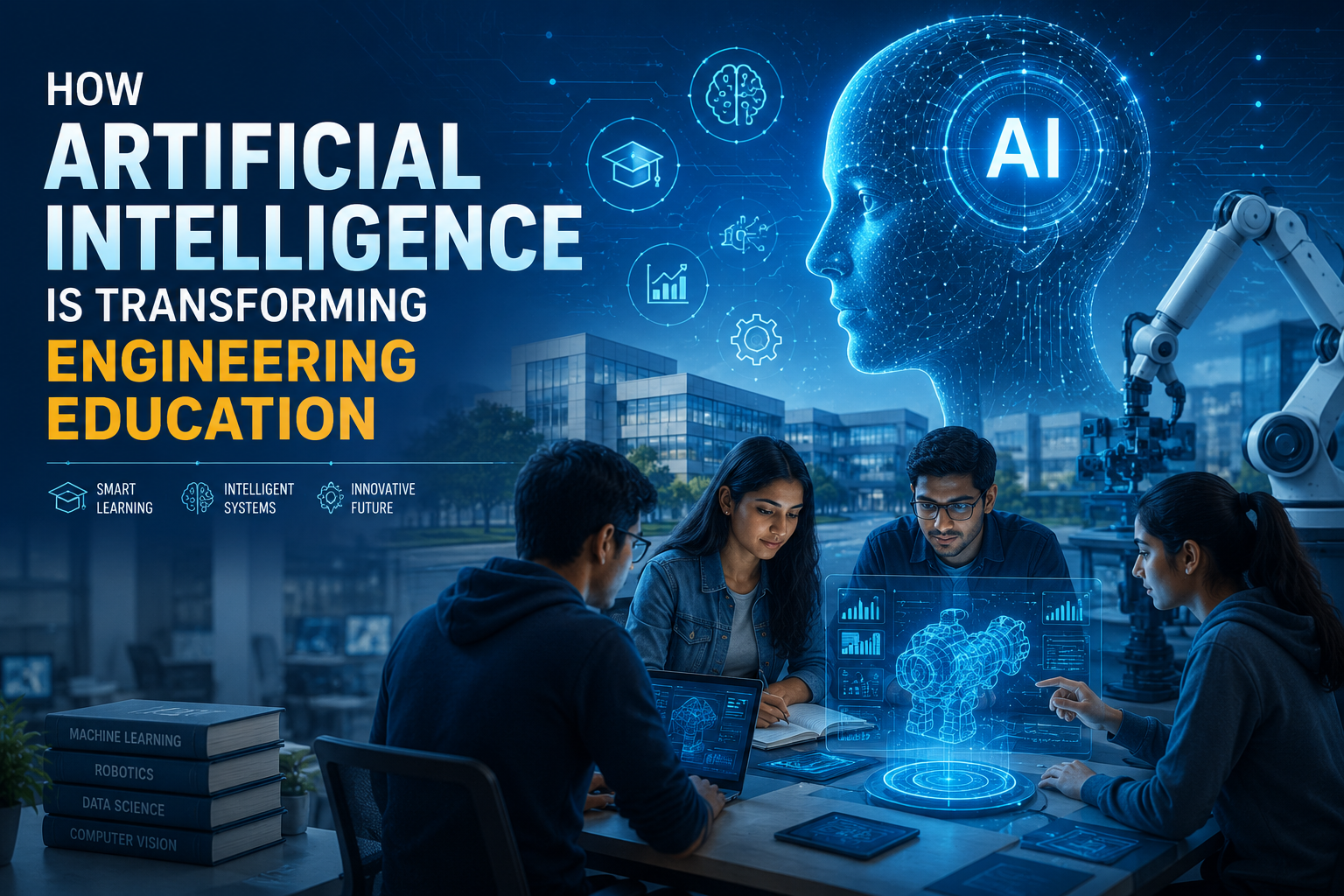
Why AI Matters in Engineering Education Today
Engineering education is changing rapidly. Earlier, the focus was mainly on classroom lectures, textbook learning, and end-semester examinations. Today, the expectation is different. Students must be able to solve real problems, work with data, use intelligent tools, adapt to modern technologies, and think like engineers who are ready for industry.
Artificial Intelligence helps bridge this gap. It supports personalized learning, faster doubt clarification, smarter assessments, simulation-based practice, coding assistance, content generation, and advanced analytics. These benefits make education more flexible, more effective, and more relevant to the needs of the modern world.
The real value of AI is not only in automation. Its deeper impact lies in improving the quality of learning, increasing student engagement, and helping every learner move at a better pace with clearer understanding.
How AI is Changing Engineering Education
1. Personalized learning
AI can understand student performance patterns and provide customized learning support. A student who struggles in programming, mathematics, or electronics can receive more practice, targeted exercises, and suggested resources. This makes learning more student-centered instead of one-size-fits-all.
2. Faster and smarter doubt clarification
AI chat tools and intelligent assistants help students get immediate explanations, examples, summaries, and coding help outside class hours. This strengthens learning continuity and reduces dependency on delayed support.
3. Better classroom engagement
Teachers can use AI-generated quizzes, presentations, visual aids, and interactive content to make classes more engaging. Complex topics become easier to understand when supported by simple examples, visuals, and adaptive content.
4. Industry-aligned skill development
AI helps students practice the same tools and workflows being used in modern companies. This includes coding assistants, data analysis tools, simulation platforms, design tools, and project planning systems. Students become more confident and job-ready.
How NBKRIST Uses AI to Improve Education Standards
NBKR Institute of Science and Technology is moving AI from theory into practice by integrating it into the educational ecosystem. The objective is not merely to talk about AI, but to use AI in a way that improves teaching quality, student performance, academic discipline, and professional readiness.
Academic enrichment
AI tools are used to simplify difficult concepts, prepare teaching material, create question banks, summarize notes, and support faculty with better content delivery. This helps classes become more focused and effective.
Student learning support
Students use AI for brainstorming, coding help, report drafting, project explanations, literature summaries, and concept revision. This improves independent learning and helps them study in a more disciplined and modern way.
Project and innovation culture
AI has become a strong support system for mini projects, major projects, research ideas, and prototype development. Students can validate ideas faster, experiment with models, and improve problem-solving confidence.
Bridging education and industry
NBKRIST is ensuring that students do not remain limited to outdated methods. By adopting AI-driven tools and practices, the institution is helping students stay closer to present industry standards and future workplace needs.
AI Tools Used in Education
AI in engineering education becomes powerful when the right tools are used responsibly. These tools support teaching, learning, coding, research, content creation, and technical communication.
ChatGPT / AI Assistants
Used for concept explanation, brainstorming, draft writing, code support, summaries, and learning assistance.
GitHub Copilot
Supports programming students with code suggestions, faster development, debugging help, and coding practice.
Canva AI
Helps create posters, presentations, infographics, seminar materials, and visually rich academic content.
Google Gemini / AI Search Tools
Useful for structured explanations, research support, topic comparison, and quick learning assistance.
Grammarly / Writing Assistants
Improves grammar, clarity, tone, and academic writing quality in reports, documentation, and blog content.
Simulation and Analytics Tools
Used in engineering labs and academic projects to test ideas, analyze outcomes, and support practical learning.
These tools must be used ethically and with academic discipline. AI should support learning, not replace learning. The goal is to help students think better, work better, and build stronger professional capability.
What AI Brings to Students
Future of Engineering Education with AI
The future engineer will not be defined only by marks and memorization. The future engineer will be defined by the ability to work with data, use intelligent tools, understand automation, communicate clearly, and solve problems creatively.
AI will continue to change laboratories, classrooms, projects, internships, and research. Institutions that embrace this transformation will grow stronger. Institutions that delay it risk becoming outdated. NBKRIST is choosing the path of adaptation, quality, and continuous improvement.
By integrating AI into mainstream education, NBKRIST is ensuring that students are not just studying engineering, but are experiencing the future of engineering education itself.